When a child starts playing the violin, the first lessons are full of new words: bridge, fingerboard, frog, pegs… This short guide explains every part of the violin and bow in simple terms.
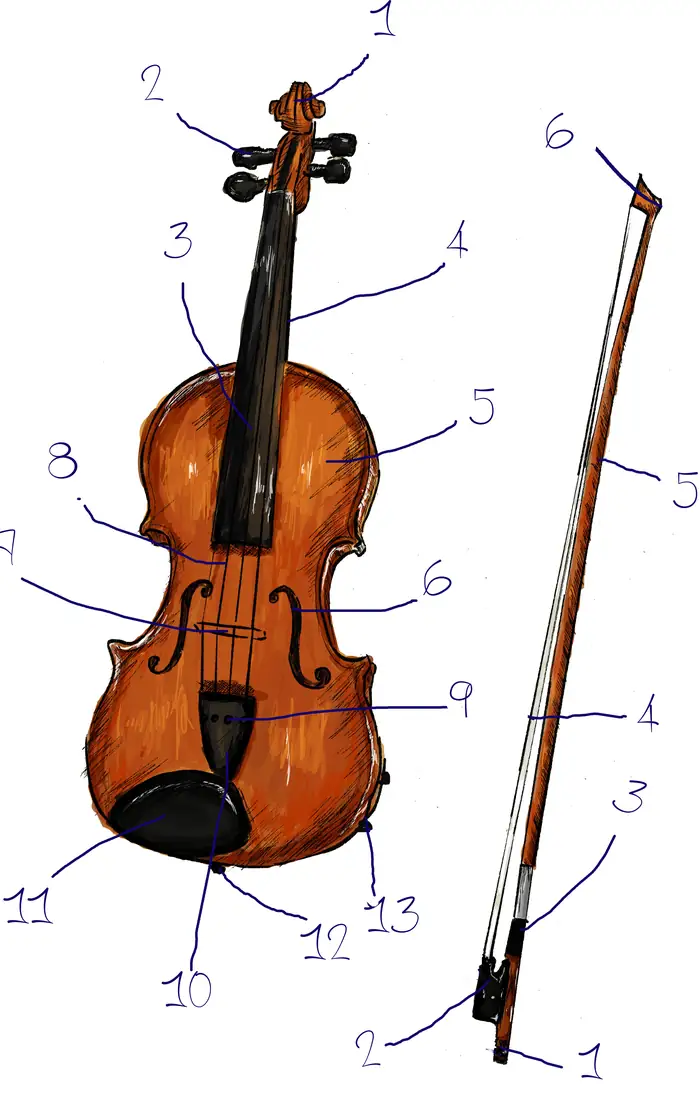
Violin
- scroll
- tuning pegs
- fingerboard
- neck
- body
- f-holes
- bridge
- strings (E, A, D, G)
- fine tuners
- tailpiece
- chinrest
- end pin
- shoulder rest
Bow
- screw
- frog
- pad
- hair
- stick
- tip
The head: scroll and pegs
The scroll is the carved ornament at the very top of the violin. Below it are the four tuning pegs – wooden pins that the strings are wound around. Turning the tuning pegs tightens or loosens the strings, so they are used for tuning.
Neck, fingerboard and nut
The neck joins the head to the body. On it sits the fingerboard – a smooth black board, usually ebony, where the fingers of the left hand press the strings. Unlike a guitar, the violin has no frets, so violinists learn exactly where to place each finger. The nut is the small ridge at the top of the fingerboard where the strings rest.
Strings
The violin has four strings tuned in fifths: G, D, A and E – from lowest to highest. Pressing a string onto the fingerboard shortens its vibrating length and gives a higher note. The free game Notko Violin helps children learn the notes on each string.
Body, f-holes and bridge
The body is a hollow wooden box that amplifies the sound of the strings. The top plate is usually spruce, while the back and the ribs (the sides) are maple. The f-holes, named after their shape, let the sound out of the body.
The bridge is a thin piece of wood that holds the strings above the body and passes their vibrations to the top plate. It is not glued – only the tension of the strings keeps it in place, so it is worth checking now and then that it stands straight.
Tailpiece, fine tuners, chinrest, end pin and shoulder rest
The tailpiece holds the strings at the lower end of the violin. It often has fine tuners – small screws for precise tuning, especially useful on smaller violins. The chinrest is attached at the lower edge for the chin, and the end pin at the very bottom holds the tailpiece. The shoulder rest attaches to the back of the violin and rests on the shoulder, making the violin easier and more comfortable to hold.
What is the sound post?
Inside the violin, under the bridge, stands the sound post – a thin round stick connecting the top and back plates. It is barely visible from outside (you can glimpse it through the f-hole on the E-string side), yet it has a big influence on the sound. If it falls, take the violin to a luthier – never try to put it back yourself.
Parts of the bow
The bow has a stick, usually made of pernambuco or carbon fibre, and hair – a ribbon of horsehair. At the lower end is the frog, where the bow is held, and the screw at the very end tightens or loosens the hair. The pad is a small piece of leather next to the frog that protects the stick where the thumb rests. The tip is the upper end of the bow. Before playing, the hair is gently tightened and rosined; after playing, it is always loosened.
Coming soon: Parts of the Violin poster
Studio Pizzicato is preparing an illustrated poster with the names of all the parts of the violin and bow – for a child’s room, practice corner or teaching studio. Sign up to be the first to know when it’s available.


